
What is Quantum Mechanics?
Quantum mechanics is a branch of physics that deals with the behavior and interactions of particles at the atomic and subatomic level. It helps us understand the strange and seemingly random phenomena that occur at these small scales, such as the uncertainty principle and wave-particle duality.
The Uncertainty Principle
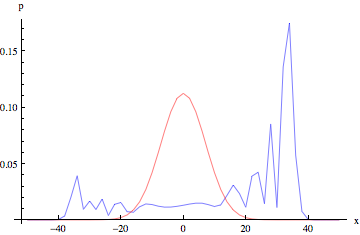
One of the most well-known concepts in quantum mechanics is the uncertainty principle. This principle states that it is impossible to know both the exact position and momentum of a particle at the same time. The more accurately we measure one of these properties, the less accurately we can measure the other.
Wave-Particle Duality
Another concept in quantum mechanics is wave-particle duality. This means that particles, such as electrons, can exhibit both wave-like and particle-like properties. For example, an electron can sometimes behave like a wave, spreading out and interfering with itself, but it can also behave like a particle, with a specific location and momentum.
Quantum States
In quantum mechanics, particles can exist in different energy levels or "quantum states." These quantum states are determined by the probability of finding a particle in a certain location or with a certain amount of energy. When a particle "jumps" between quantum states, it releases or absorbs energy in the form of a photon, which is a particle of light.
Quantum Mechanics and Technology
Quantum mechanics has had a huge impact on our technology and daily lives. For example, transistors, the tiny components that make up our computer chips, rely on the behavior of electrons at the quantum level. Quantum computers, which are still in development, have the potential to solve problems much faster than traditional computers due to their ability to manipulate quantum states.
Overall, quantum mechanics helps us understand the strange and complex world of the very small. It has had a significant impact on our understanding of the universe and has led to many technological advancements. It may seem strange and counterintuitive at times, but it is an essential field of physics that helps us make sense of the world around us.
Quantum Mechanics and the Double Slit Experiment
One experiment that demonstrates the strange and counterintuitive nature of quantum mechanics is the double slit experiment. In this experiment, scientists shine a beam of light through two slits and observe the pattern that forms on a screen behind the slits. When the light is shone through one slit at a time, the pattern on the screen is a single line. However, when both slits are open, the pattern on the screen becomes a series of bright and dark bands.
The strange thing about this experiment is that when scientists tried to observe the individual particles that make up the beam of light (such as photons or electrons), they found that each particle behaved like a wave and passed through both slits at the same time, leading to the interference pattern on the screen. This means that the particles somehow "know" about both slits and interfere with themselves, even though they should not be able to interact with each other.
Quantum Entanglement
Another strange phenomenon in quantum mechanics is quantum entanglement. This occurs when two particles become connected in such a way that their quantum states become intertwined. This means that if something happens to one particle, it will affect the other particle, no matter how far apart they are. This has been demonstrated in experiments where two entangled particles are separated by large distances and yet still exhibit a connection.
Quantum entanglement has the potential to revolutionize communication and computing, as it allows for information to be transmitted instantly over any distance. However, it is still not fully understood and scientists are continuing to study its implications and applications.
Conclusion
Quantum mechanics is a fascinating and complex field of physics that helps us understand the behavior of particles at the atomic and subatomic level. It has led to many technological advancements and has opened up new possibilities for communication and computing. While it may seem strange and counterintuitive at times, it is an essential part of our understanding of the universe and will continue to play a major role in scientific research and development in the future.