
The Fundamentals of Heat Transfer: Types, Coefficients, and Applications
Introduction
Heat transfer is the movement of thermal energy from one body or system to another. There are three primary methods of heat transfer: conduction, convection, and radiation.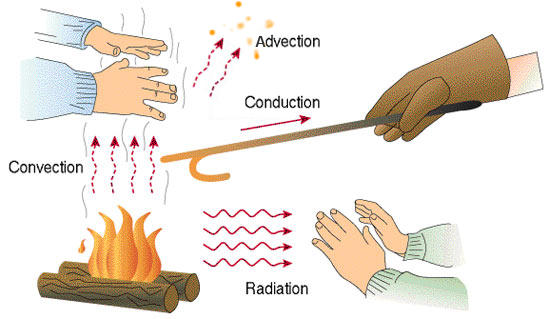
Conduction
Conduction is the transfer of heat through direct contact. When two objects with different temperatures are in contact, heat will transfer from the hotter object to the cooler object until they reach the same temperature. The rate of conduction depends on the material and the temperature difference between the two objects. For example, metals are good conductors of heat, while plastics are poor conductors.Convection
Convection is the transfer of heat through the movement of fluids. When a fluid is heated, it expands and becomes less dense. This causes it to rise, while cooler, denser fluid sinks. This movement of fluids creates a circulation pattern, which can transfer heat from one place to another. Convection can occur in both liquids and gases.Radiation
Radiation is the transfer of heat through electromagnetic waves. It does not require a medium (such as a fluid or solid) to transfer heat, and can occur in a vacuum. The sun's energy reaches the Earth through radiation, and heat can be transferred between objects through radiation as well. The rate of heat transfer through radiation depends on the surface area, temperature, and emissivity (the ability to radiate energy) of the objects.Heat Transfer in Engineering
Heat transfer plays a crucial role in many engineering applications, such as power generation, HVAC (heating, ventilation, and air conditioning), and refrigeration. Engineers must consider heat transfer when designing devices and systems to ensure that they function safely and efficiently.
Heat Transfer Coefficients
Heat transfer coefficients are used to quantify the rate of heat transfer between two bodies or systems. The heat transfer coefficient is dependent on the properties of the materials involved, the surface area of the bodies, and the temperature difference between them. Higher heat transfer coefficients indicate that heat is transferred more quickly between the bodies.Heat Transfer by Conduction
Conduction is the transfer of heat through direct contact between two bodies. The rate of heat transfer by conduction is given by the formula:q = kA(ΔT)/d
where:- q is the heat transfer rate (energy per unit time)
- k is the thermal conductivity of the material
- A is the surface area of the body
- ΔT is the temperature difference between the two bodies
- d is the distance between the two bodies
Heat Transfer by Convection
Convection is the transfer of heat through the movement of fluids. The rate of heat transfer by convection is given by the formula:q = hA(ΔT)
where:- q is the heat transfer rate (energy per unit time)
- h is the convection heat transfer coefficient
- A is the surface area of the body
- ΔT is the temperature difference between the fluid and the body
Heat Transfer by Radiation
Radiation is the transfer of heat through electromagnetic waves. The rate of heat transfer by radiation is given by the formula:q = σA(T41 - T42)
where:- q is the heat transfer rate (energy per unit time)
- σ is the Stefan-Boltzmann constant (5.67 x 10⁻⁸ W/m2K4)
- A is the surface area of the body
- T1 is the temperature of the body
- T2 is the temperature of the surroundings
Applications of Heat Transfer
Heat transfer plays a vital role in many practical applications, including:- Power generation: Heat transfer is used to generate electricity in power plants. For example, steam is generated by heating water through the burning of fossil fuels or the use of nuclear reactions. The steam is then used to power a turbine, which generates electricity.
- HVAC (heating, ventilation, and air conditioning): Heat transfer is used to regulate the temperature and air quality in buildings and vehicles.
- Refrigeration: Heat transfer is used to remove heat from a system in order to cool it down. This is done using a refrigeration cycle, which involves the evaporation and condensation of a refrigerant. The refrigerant absorbs heat from the system as it evaporates, and then releases the heat as it condenses. This process is used in refrigerators, air conditioners, and other cooling systems.
- Cooking and food processing: Heat transfer is used to cook and preserve food. For example, heat can be transferred through conduction, convection, and radiation in cooking appliances such as ovens, stovetops, and grills. Heat transfer is also used in food processing, such as pasteurization and sterilization.
- Automotive engineering: Heat transfer is an important consideration in automotive engineering. The engine, exhaust system, and brakes all generate significant amounts of heat, which must be managed to ensure the safety and efficiency of the vehicle. Heat exchangers are often used to transfer heat from one fluid to another, while insulation is used to reduce heat transfer.
- Aerospace engineering: Heat transfer is a critical factor in the design of aircraft and spacecraft. The extreme temperatures encountered during flight, as well as the need to maintain a comfortable environment for the passengers and crew, require careful management of heat transfer. Heat exchangers, insulation, and thermal protection systems are all used to regulate heat transfer in aerospace vehicles.