
Understanding the Properties of Gases
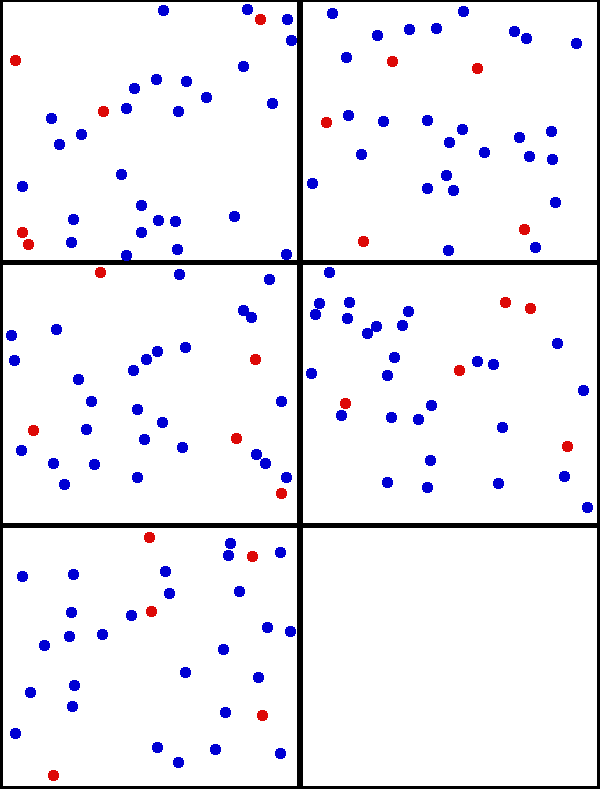
Gases are a state of matter that is characterized by a lack of a definite shape or volume. They are composed of molecules that are widely spaced and constantly moving, colliding with each other and the walls of their container. There are several properties that are unique to gases, and understanding these properties can help us understand how gases behave and how they can be used in various applications.
Expandability
One of the most notable properties of gases is their ability to expand to fill their container. This is because the molecules of a gas are widely spaced and have a lot of kinetic energy, allowing them to move freely and expand to fill the available space. This property of gases is useful in applications where the volume of a gas needs to be changed, such as in airbags or weather balloons.
Compressibility
Another property of gases is their ability to be compressed. Because the molecules of a gas are widely spaced and constantly moving, they can be squeezed together by increasing the pressure on the gas. This is useful in applications where a small volume of gas needs to be stored at a high pressure, such as in gas cylinders or compressed air tanks.
Diffusion
Gases also have the property of diffusion, which is the ability to mix with other gases. This occurs because the molecules of a gas are constantly moving and colliding with each other, allowing them to spread out and mix with other gases. This property is useful in applications where gases need to be mixed or separated, such as in air purification systems or industrial processes.
Pressure
Pressure is the force exerted by a gas on the walls of its container. It is caused by the constant collision of gas molecules with the walls of the container. The pressure of a gas is dependent on the number of molecules in the gas, the temperature of the gas, and the volume of the container. The pressure of a gas can be measured using a pressure gauge or a barometer.
Temperature
Temperature is a measure of the average kinetic energy of the molecules in a gas. As the temperature of a gas increases, the molecules have more kinetic energy and move faster, leading to an increase in the pressure of the gas. This is known as the ideal gas law, which states that the pressure of a gas is directly proportional to its temperature and the number of molecules in the gas, and inversely proportional to the volume of the container.

Conclusion
Gases have several unique properties that make them important in a variety of applications. Understanding these properties can help us understand how gases behave and how they can be used in various situations. Whether it's expanding to fill a container, being compressed to fit into a small space, diffusing with other gases, or exhibiting changes in pressure and temperature, gases have a lot of versatility and usefulness in the world around us.